

Imagine a fear so powerful it decides what you eat. It tells you where you can go. It whispers to you in the middle of a party, on a long-awaited trip, or just as you’re falling asleep. This is not a fear of spiders or heights. This is a deep, daily dread of something your own body might do: the Fear of Throwing Up.
For millions of people, this fear of throwing up isn’t just an “icky feeling.” It’s a mental health condition that builds a silent prison. It’s canceling plans because a restaurant menu looks “risky.” It’s carrying a plastic bag “just in case” and feeling your heart pound at a child’s cough. It’s the exhausting work of scanning your body all day, every day, for any sign of danger, all driven by the fear of vomiting.
If you live with this, you know the loneliness. You’ve made excuses. You’ve felt the shame of a fear of throwing up that others don’t understand. You are not weak. You are not broken. You are struggling with a very real and treatable problem called emetophobia—the clinical name for this intense fear of vomit.
This guide is for you. We will walk through what this fear of throwing up really is—why it happens in your brain and body. We will look at the symptoms that are more than “just nerves.” We will explore the causes, from past trauma to an anxious mind. Most importantly, we will map out the proven treatment paths that lead back to freedom. This is about understanding the prison of the fear of throwing up, so you can find the key and walk out.
What Is the Fear of Throwing Up? (Meaning Explained)
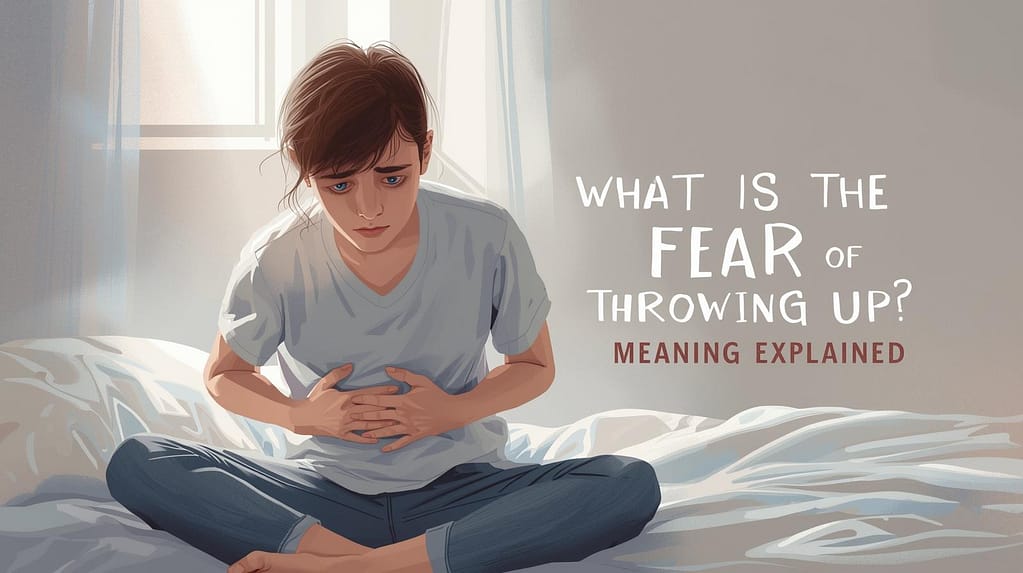
The fear of throwing up is a very strong and scary feeling. It is more than just not liking to be sick. It is a powerful anxiety disorder that makes a person feel terrified. They are scared of vomiting. They are scared of feeling like they might vomit. They might even be scared of seeing or hearing about someone else vomiting.
In plain terms, the fear of vomiting means a state of full-body panic hijacks you. Your heart thunders, your skin grows clammy, all sparked by the mere idea of sickness. This isn’t an everyday concern. It’s a consuming terror that convinces your entire system a true crisis is unfolding.
What is the phobia of throw up called? This extreme fear has a special name. Doctors and mental health experts call it Emetophobia. It is known as a specific phobia. This means it is a big, lasting fear of one particular thing or situation.
It’s crucial to distinguish a clinical fear of vomiting from everyday nervousness about nausea. When most people feel queasy, they have a passing thought: “Ugh, I hope this passes.” They acknowledge it and continue their day.
For someone with emetophobia, that same sensation triggers a completely different script. The mind doesn’t see discomfort—it sees a dire forecast. The immediate, automatic thought is: “This sensation is a guarantee. I am about to be violently sick. I will be helpless and humiliated. I must do anything to prevent this catastrophe.”
This isn’t a worry; it’s catastrophic thinking that declares a state of emergency. This extreme interpretation can fuel relentless anxiety for hours or days, dictating what they eat, where they go, and how they live, effectively putting their life on hold to manage a perceived threat.
Real Experience: “When my son said his stomach hurt at school, my own stomach dropped. For him, it was a small ache. For me, my brain screamed, ‘Norovirus. He’s going to vomit. You will catch it. You will be sick for days.’ I spent the whole drive home in a panic, planning how to isolate him, cleaning everything in sight. My fear of his sickness was bigger than my care for his comfort at that moment. That’s the shame of it.”
What Is the Fear of Throwing Up Called? (Phobia Name & Pronunciation)
Knowing the official name for your fear is a big first step. It helps you find the right information and help.
- Fear of throwing up names: The main name is Emetophobia.
- Fear of throwing up a phobia name: This is also Emetophobia.
- Fear of vomit phobia name: People might search for vomit phobia or barfing fear, but the correct medical term is still Emetophobia.
What is the phobia of throw up called? If you are looking for help, use the word Emetophobia. Therapists and doctors will know what you mean. You might also see vomiting anxiety or nausea fear.
Fear of throwing up pronunciation:
The word can look long, but it is easy to say: em-et-oh-FOE-bee-uh.
- Em like the letter “M”.
- et like in the word “pet”.
- oh like the letter “O”.
- FOE like the word “foe” or enemy.
- bee-uh like “bee” then “uh”.
Saying the name out loud can feel powerful. It means this scary feeling has a definition. It is a real mental health condition that many people have. You are not alone. And because it has a name, there are evidence-based treatments for it.
Is Fear of Throwing Up a Real Phobia or OCD?

This is a very common question. Fear can act like two different things. It can be its own phobia. Or it can be a part of a different problem called OCD. Sometimes, it is both together.
Fear of throwing up phobia vs fear of throwing up OCD:
- As a Phobia (Emetophobia): The main feeling is fear. The person is afraid of vomiting itself. They will avoid anything linked to sickness. They avoid sick people, certain foods, or places like hospitals. The goal is to stop the scary event from ever happening.
- As an OCD Theme: Here, the main problem is unwanted thoughts. The person has scary intrusive thoughts like, “What if I get sick right now?” These thoughts cause panic. To make the panic stop, they do a ritual or a compulsion. They might wash their hands over and over. They might ask for reassurance again and again. The goal is to cancel out the scary thought.
How OCD increases vomiting fear:
OCD creates a bad cycle. The scary thought pops up. This causes terrible anxiety. The person does a compulsion (like counting or checking). The anxiety goes down for a minute. This teaches the brain a wrong lesson. The brain thinks, “The only reason you didn’t get sick is because you counted to ten.” So next time, the thought feels even more dangerous. The person feels they must do the ritual. This is the fear reinforcement cycle. It makes the vomiting anxiety grow stronger and stronger.
Key differences explained clearly:
Think of it like this:
- Phobia: You see a dog (trigger). You feel afraid. You cross the street to avoid it (avoidance).
- OCD: A thought pops into your head, “What if a dog bites me?” There is no dog around. You feel afraid. You say a special phrase in your mind to feel safe (compulsion).
A licensed therapist or clinical psychologist can help figure out which one it is. The good news is that the best behavioral therapy for both problems is similar.
Real Experience: “My emetophobia is pure OCD. I’d be sitting calmly, and a thought would flash: ‘You swallowed wrong. You’re going to choke and vomit.’ My heart would race. My compulsion was to swallow over and over on purpose, ‘testing’ my throat. I’d do this 50 times an hour. It was exhausting. I wasn’t afraid of a virus; I was a prisoner to the thoughts in my own head.”
Read More: Blessed Sacrament Adoration Prayers: Feel God’s Presence
Fear of Throwing Up in Public: Why It Feels Worse
For many people with this fear, the worst idea is throwing up in public. This fear mixes physical terror with deep social anxiety, shame, and embarrassment.
It is not just about being sick. It is about being seen. The thoughts are: “People will think I’m gross.” “I will be so embarrassed.” “I will cause a scene and ruin everything.” This fear of loss of dignity can feel as bad as the fear of vomiting itself.
This social anxiety connection leads to many avoidance behaviors. A person might:
- Never eat at parties or restaurants.
- Avoid buses, trains, or planes where they can’t easily leave.
- Always need to know where the closest bathroom is.
- Leave fun events early if they feel any stomach sensation.
- Say no to jobs or trips that feel “risky.”
The panic triggers are everywhere. Being in a crowded room. Sitting in the middle of a long row at a movie. Seeing a long line for a public bathroom. The brain sees these social traps as real danger. This can lead to full panic attacks. To avoid this, the person may choose social isolation. This makes their world very small.
Real Experience: I loved my friend’s birthday dinner at a nice restaurant. But I only ordered water. I was too scared to eat the rich food in front of everyone. I spent the whole night smiling, but inside I was mapping my escape route to the bathroom. The fun was gone, replaced by a calculator of risk and shame. I went home hungry and sad, while everyone else shared dessert and laughed.
Fear of Throwing Up Symptoms You Shouldn’t Ignore

This fear shows up in your body, your mind, and your daily life. If you see these signs in yourself, it is time to take them seriously.
Physical symptoms:
Your entire system slams into high alert, primed for a threat that feels utterly real.
- Panic Attacks: Your heart races (increased heart rate). You might have chest tightness, feel dizzy, start sweating, or shaking.
- Anxiety Nausea: This is a cruel trick. The fear of vomiting actually causes an upset stomach and nausea. Then, you get more scared because you feel nauseous! It is a terrible cycle.
- Hypervigilance: This means you are always checking inside your body. You notice every little gurgle, twinge, or feeling. You are on high alert for any sign of sickness.
Emotional and psychological symptoms:
- Constant Worry: You have persistent anxiety or anticipatory anxiety. You worry about getting sick tomorrow, next week, at the upcoming event.
- Catastrophic Thoughts: Your mind jumps to the worst possible outcome. A small feeling becomes a disaster in your thoughts.
- The Heavy Shame: Beneath the fear sits shame. You think, “Why am I like this?” It makes your anxiety feel embarrassing, like a secret flaw you must hide.
Daily life impact:
This is how fear steals your life.
- Food Rules: You eat only a few “safe foods.” You avoid restaurants and social meals. You might overcook food to kill germs.
- Social Withdrawal: You start avoiding social situations. You say no to parties. You avoid hospitals and anyone who is sick.
- Work/School Problems: You might miss days because of anxiety. This is occupational impairment or academic avoidance. You might turn down a promotion that requires travel.
- Rituals: You may check expiration dates on all food. You wash your hands too much. You might carry trash bags or mints “just in case.”
- Safety Planning: You always sleep near a bathroom. You have a refusal to eat outside the home.
This restricted lifestyle and impaired daily functioning are clear signs that the fear is in control.
Common Causes of Fear of Throwing Up
No one chooses this fear. It usually starts from a mix of reasons.
Past trauma or illness: This is a very common cause. A bad memory of vomiting, especially as a child, can leave a deep mark. If you were very sick, or if you were sick in a scary or embarrassing place (like vomiting in public), the memory feels dangerous. Your brain wants to protect you from ever feeling that way again.
Anxiety disorders: Some people are born with a more sensitive, anxious temperament. They get nervous more easily. If you are already an anxious person, the scary, out-of-control feeling of vomiting can become a big target for your worry.
Heightened bodily awareness: We all feel signals from our bodies, like hunger or a full stomach. Some people feel these signals much more strongly. This is called heightened bodily awareness. For them, normal digestion is loud and clear. They notice every little sensation. It is easy to mistake a normal stomach gurgle for a sign of danger.
Height phobia causes comparison (fear overlap):
It helps to compare it to a fear of heights (which is called Acrophobia). They are similar in many ways:
- Trauma: A bad fall or a bad sickness can start it.
- Learned Fear: Seeing a parent be very afraid.
- Catastrophic Thinking: The mind jumps to the worst end: “One step means a fatal fall” / “This feeling means I’ll choke from vomiting.”
- Loss of Control: The feeling that something terrible is about to happen and you can’t stop it.
Both fears come from a brain that is trying too hard to protect you. It sees a small signal (like a stomach ache or a high place) and reacts as if it is a huge threat.
Fear of Throwing Up and Intrusive Thoughts

Intrusive thoughts are the secret engine of this fear for many people. They are unwanted, scary thoughts or pictures that suddenly pop into your mind. They feel scary and real.
A helpful comparison is the sudden, jarring fear of throwing yourself from a height. Picture yourself on a perfectly secure balcony. Without warning, your mind whispers, “You could jump.” The thought is horrifying. It is the opposite of your intention. Yet its mere presence is so alarming that you instinctively retreat, frightened not by the ledge, but by the unexpected darkness within your own thoughts.
This is the cruel logic of emetophobia. Out of a clear blue sky, a single, terrifying sentence forms in your mind: “What if you get sick right now?” Your stomach is calm. There is no logical trigger. Yet, the thought doesn’t feel like a random idea—it feels like a premonition, a dire forecast from your own brain. You mistake the thought for a prophecy: “My mind is showing me this because it’s what’s coming next.” And in that moment, the forecast becomes a self-fulfilling storm of instant panic.
Catastrophic thinking patterns then make it worse:
- “This feeling is different. It’s really bad this time.”
- I’m scared that if I start being sick, I’ll never be able to stop.
- I’m scared I’ll be so sick that I won’t be able to breathe.
Why the brain exaggerates danger: Your brain has one main job: keep you alive. Its alarm system (the amygdala) is very old and very careful. It would rather sound a false alarm 100 times than miss one real tiger. When you had a bad experience with vomiting, your brain marked it as “TIGER.” Now, any tiny sign that reminds it of that experience (a stomach gurgle, the word “sick”) makes the alarm go off. It is not trying to hurt you. It is trying, in a clumsy way, to save you from a memory of danger.
Real Experience: I was curled up in bed, lost in a novel and utterly calm. Out of nowhere, a crystal-clear sentence inserted itself into my mind: ‘What if you wake up at 2 AM and vomit?’ In an instant, the peace shattered. My heart began to hammer against my ribs. For the next sixty minutes, I wasn’t reading; I was in a mental war room, strategizing for a stomach virus that didn’t exist. That’s the terrifying alchemy of an intrusive thought—it can conjure a complete physiological panic attack from a single, silent sentence.
Fear of Throwing Up vs Fear of Throwing Things Away
These two fears seem very different. But they share a deep root: a desperate need for control. The fear of throwing things away is often linked to hoarding or OCD(sometimes called Disposophobia).
A person with this fear thinks, “If I throw this away, I will need it later and not have it. That will be a disaster.” Their compulsion is to keep and save everything.
Look at the similarity:
- Emetophobia: “If I control everything I eat and touch, I can control the unpredictable terror of vomiting.”
- Fear of Throwing Things Away: “By holding onto every object, I build a fortress against future regret. If I control my possessions, I can control the chaos of ‘what if’ that tomorrow might bring.”
Both are control-based fears. The person is trying to manage deep anxiety by controlling their environment.
How avoidance strengthens phobias:
This is the rule for all anxiety. Let’s break down the cycle:
- Fear: Thought of vomiting / Thought of discarding an item.
- Action: Avoid the trigger (leave the room) / Perform the compulsion (keep the item).
- Result: The anxiety goes down. You feel relief.
- The Brain’s Lesson: It learns something wrong. It thinks, “Phew! The only reason disaster didn’t happen is because you avoided/ritualized. The threat was real. Your safety is necessary for survival.”
Every time you avoid or do a ritual, you make the fear stronger. You teach your brain that the world is a dangerous place and your only safety is in these rules. Breaking the anxiety cycle means stopping this pattern.
What Do People Say About Fear of Throwing Up? (Reddit Insights)

Websites like Reddit have communities where people talk honestly about emetophobia. Reading fear of throwing up Reddit threads shows you are not alone. The stories are very similar.
Common shared struggles:
- The “Safe Food” List: Many people talk about living on plain foods like crackers, rice, bananas, and plain pasta for years.
- The “Safety Kit”: Never leaving home without a plastic bag, mints, ginger candy, water, and medicine.
- The Lies: Making excuses like “I already ate” or “I have a headache” to get out of social events involving food.
- The Confusion: “Is this nausea real, or is it just my anxiety? I can’t tell anymore.”
- The Big Dreams: “I want to be a parent, but the fear of morning sickness or my child getting sick terrifies me.”
What sufferers feel but don’t say:
On Reddit, people share the hidden shame:
- “I feel like a child.” They are adults who are secretly terrified of a normal body function.
- “I’m missing my own life.” They skip weddings, vacations, college experiences, and simple dinners.
- “The exhaustion is bone-deep.” The unending mental labor of scanning for threats, planning escapes, and managing constant worry is a full-time job that drains your spirit.
- “I’m terrified of my own doctor’s reaction.” There’s a paralyzing fear that revealing this fear will be met with dismissal, a laugh, or a blank stare that confirms your deepest worry: that it’s all in your head.
- “My loneliness has an audience.” You can be surrounded by caring people and still feel utterly isolated, because no one outside the prison walls can truly comprehend the architecture of your specific cell.
Seeing these stories can be sad, but also hopeful. It shows this is a real problem. It also shows a community that shares tips, therapist names, and support. It is proof of people rebuilding confidence and reclaiming daily life.
Fear of Throwing Up Treatment Options That Actually Work
There is hope. Emetophobia is treatable. You do not have to live like this forever. Good fear of throwing up treatment can help you get your life back.
Therapy-based approaches are the most effective:
- Cognitive Behavioral Therapy (CBT): This approach teaches you to become a detective of your own thoughts. You learn to identify the automatic, alarmist predictions—like “I will definitely vomit”—and gently but firmly challenge their evidence. Through practice, you replace these fear-fueled statements with more balanced, reality-based ones, such as, “This is a wave of anxiety, and like all waves, it will crest and then subside.”
- Exposure and Response Prevention (ERP): Think of this as the gold-standard training for your brain’s alarm system. As a specialized form of CBT, it works by carefully and gradually reintroducing you to your fears in a controlled setting. You might begin by simply writing the word “vomit,” then progress to listening to the sound of someone gagging in a movie. The critical rule is that you face these triggers while resisting all your usual safety behaviors—no checking, no reassurance-seeking, no escape. By doing so, you prove to your nervous system that the perceived threat is not a real danger, systematically dismantling the fear cycle link by link.
- Acceptance and Commitment Therapy (ACT): This therapy teaches you to accept anxious thoughts as just thoughts—not truths. You learn to let them be there without fighting them, while you go live your life the way you want to live it.
Medication support when needed:
Therapy is the main treatment. But sometimes, medicine can help too, especially if anxiety is very severe.
- SSRIs: These are a common type of antidepressant. They are also very good at lowering overall anxiety and helping with OCD thoughts. They help turn down the volume of your fear, so therapy is easier to do.
- Anti-nausea Medicines: Doctors are careful with these. Using them too much can become a safety ritual. But sometimes, just knowing you have one can reduce panic, as long as you don’t use it to avoid fear.
Working with a mental health provider like a psychologist or psychiatrist will help you find the right plan.
Cognitive Behavioral Therapy (CBT) for Vomiting Phobia

CBT is like being handed the long-lost instruction manual for your own mind. It’s a practical toolkit, not philosophy, focusing entirely on the faulty wiring in the present moment.
Exposure therapy explained:
Think of exposure like a vaccine. A vaccine gives your body a tiny, safe piece of a germ so it can learn to fight it. Exposure therapy gives your brain a tiny, safe dose of your fear. This teaches your brain that fear is not dangerous.
You and your therapist make a “fear ladder.”
- Easy Step: Say the words “throw up” out loud.
- Medium Step: Watch a cartoon where a character feels sick. Eat a new food from your “safe” list.
- Harder Step: Watch a real video of someone vomiting (starting with short clips). Make yourself feel dizzy by spinning in a chair (to mimic a nausea feeling).
You start with the easy step. You stay with the anxious feeling until it goes down on its own. You do not run away or do a ritual. This process is called habituation. When you master one step, you move up the ladder.
Rewiring fear responses:
Every time you face a trigger and survive, you create a new memory. You prove to your brain: “See? That word, that feeling, that video—it’s uncomfortable, but it’s not dangerous. I am safe.” Slowly, the old pathway in your brain that says “stomach gurgle = EMERGENCY” gets weaker. A new pathway grows that says “stomach gurgle = normal digestion.”
Long-term success rates:
Studies show that CBT and ERP have high success rates for specific phobias and OCD. Many people see a huge reduction in their fear. It is hard work. It takes courage. But it leads to long-term recovery. Success means the fear no longer makes your choices for you.
Self-Help Tips to Reduce Fear of Throwing Up Naturally
You can do things every day to help calm your nervous system. These tips support the work you do in therapy.
Breathing and grounding:
Panic hijacks your breath, turning it into quick, shallow gasps. This starves your brain of steady oxygen, directly fueling the very dizziness and nausea you fear most.
Try diaphragmatic breathing:
- Inhale gently through your nose to a slow count of four, focusing on filling your lower lungs so your abdomen softly expands.
- Hold your breath for 2 seconds.
- Exhale slowly through your mouth for six seconds. Do this five times. It sends a clear signal to your body to relax.
Use grounding to pull yourself out of your thoughts:
Name: 5 things you can see. 4 things you can feel. 3 things you can hear. 2 things you can smell. 1 thing you can taste.
Thought reframing:
Catch your scary thoughts and talk back to it.
- Scary Thought: “This nausea is real. I’m getting sick.”
- Challenge It: “How many times has this exact feeling happened because of anxiety? Almost every time. This is my fear, not the flu.”
- New Thought: “This is an uncomfortable wave of anxiety. I have ridden this wave before. It always passes.”
Diet and body awareness tips:
- Eat Small Meals: An empty stomach can cause nausea and dizziness. Eat small, bland snacks often.
- Drink Water: Dehydration causes headaches and nausea.
- Limit Caffeine: Coffee and soda can make you feel jittery and mimic anxiety.
- Practice on Purpose: In a safe place, create harmless symptoms. Run in place to get your heart racing. Shake your head to feel dizzy. This teaches your brain these feelings are not dangerous.
Fear of Heights and Fear of Throwing Up: Hidden Connection

We compared them earlier. Let’s look closer. What is the fear of heights called? It is Acrophobia.
Height phobia symptoms are very similar: dizziness, panic, sweating, a feeling of losing control, and a need to get down immediately.
Why anxiety fears overlap:
At their core, both are fears of loss of control and a terrible outcome.
- Acrophobia: “If I’m high up, I will lose control and fall.”
- Emetophobia’s Core Fear: “This sensation is a promise of total, humiliating loss of control.”
Your brain’s fear center sees both situations the same way: “DANGER: YOU ARE NOT IN CONTROL.” This is why people with one anxiety problem often have another. The real issue is a nervous system that is too sensitive. It has a hard time with uncertainty and scary body feelings like dizziness or nausea.
Knowing this can help. It means you are not fighting two separate, random monsters. You are dealing with one overactive alarm system. When you learn to calm that system for one fear, it can help with the other too.
Can You Fully Recover From Fear of Throwing Up?
Yes. You can.
Recovery expectations:
Recovery is a journey. It does not mean you will never feel nervous again. Life has stomach bugs and stress. True recovery means:
- The fear is no longer the boss of you.
- You can feel queasy and think, “This is unpleasant,” instead of “This is the end.”
- Your world gets big again. You go to restaurants, travel, see friends.
- The scary thoughts become rare and quiet. They lose their power.
Talk to a doctor or therapist if:
- The fear causes you deep distress every day.
- You are avoiding important parts of your life because of it.
- It is hurting your relationships, job, or school.
- You feel hopeless or very sad because of the fear.
You deserve a life not ruled by fear. A licensed therapist who knows about anxiety can guide you.
Living a normal, fear-free life:
This is the goal, and it is possible. It takes the brave work of therapy. It takes facing fears in small steps. It takes being kind to yourself when it is hard. People recover every single day. They get their lives back. They enjoy meals out. They travel. They become parents. They get a stomach bug and get through it, realizing they are stronger than they thought.
Final Thought: Your Life is Waiting on the Other Side of This Fear
The journey through understanding emetophobia—the intense fear of throwing up—is not just about learning facts. It’s about seeing your own struggle reflected and validated. It’s about realizing that the rituals, the avoidance, the constant panic response are not personal failings. They are the symptoms of a specific phobia or OCD theme that has learned to shout too loudly in your mind, all centered on the fear of vomiting.
Remember this: the very fact that this fear of throwing up has a name—Emetophobia—means it has been seen, studied, and most importantly, treated. The catastrophic thinking that tells you “this will never end” is the fear’s greatest trick. It is lying to you.
Recovery from the fear of throwing up is not a fairy tale of never feeling a stomach twinge again. Life is messy, and bodies are sometimes unpredictable. True recovery is something far more powerful and attainable: it is a choice.
It is the choice to eat at a new restaurant, even with a flutter of nerves. It is the choice to board a plane, trusting you can handle discomfort. It is the choice to hold your sick child, grounded in love rather than frozen in terror. It is the quiet moment when a wave of anxiety comes, and instead of spiraling, you think, “This is just a feeling. It will pass.” And it does.
The path is clear. It begins with a single, brave step: reaching out to a licensed therapist or mental health provider who understands the fear of throwing up. It continues with the hard, courageous work of exposure therapy and rewiring those fear pathways. There will be difficult days, but they are steps forward, not setbacks.
You have already lived through the hardest part: managing this fear of throwing up alone. Now imagine managing it with support, with strategy, with hope. Imagine a life where your decisions are made from desire, not dread. That life is not a distant dream. It is the proven outcome of evidence-based treatment.
Your story does not have to be defined by this fear of vomiting. Turn the page. Ask for help. Do the work. A full, vibrant, and fear-free life is not just possible—it is waiting for you to claim it. You have already shown immense strength by surviving this far. Now, channel that strength into breaking the anxiety cycle and reclaiming your daily life from the fear of throwing up. You can do this.
How to overcome fear of throwing up?
The most effective way is through professional treatment, specifically Exposure and Response Prevention (ERP) therapy, a type of Cognitive Behavioral Therapy (CBT). This involves gradually and safely facing fears (like saying the word “vomit” or eating a fear food) while stopping all safety behaviors (like checking or seeking reassurance). This retrains the brain. Medication (like SSRIs) can also help manage the underlying anxiety.
How to calm someone down with emetophobia?
Stay calm yourself. Offer quiet, non-physical reassurance like, “You’re safe. This is anxiety, and it will pass.” Help them with grounding techniques: ask them to name 5 things they can see, 4 things they can touch. Encourage slow, diaphragmatic breathing (inhale 4 secs, exhale 6 secs). Do not dismiss their fear or talk about sickness.
What is the hardest phobia to cure?
There is no single “hardest” phobia, as the cure depends on the individual. However, complex phobias that are deeply intertwined with personality or other disorders (like Agoraphobia or some cases of Emetophobia) can be very challenging. Phobias with avoidance so severe that a person cannot engage in therapy are particularly difficult to treat.
What is metathesiophobia?
Metathesiophobia is the fear of change. It is an anxiety disorder where the uncertainty and perceived loss of control associated with any change—big or small, like a new routine, job, or relationship—triggers intense fear and avoidance behaviors.